Pursue MD in India After MBBS
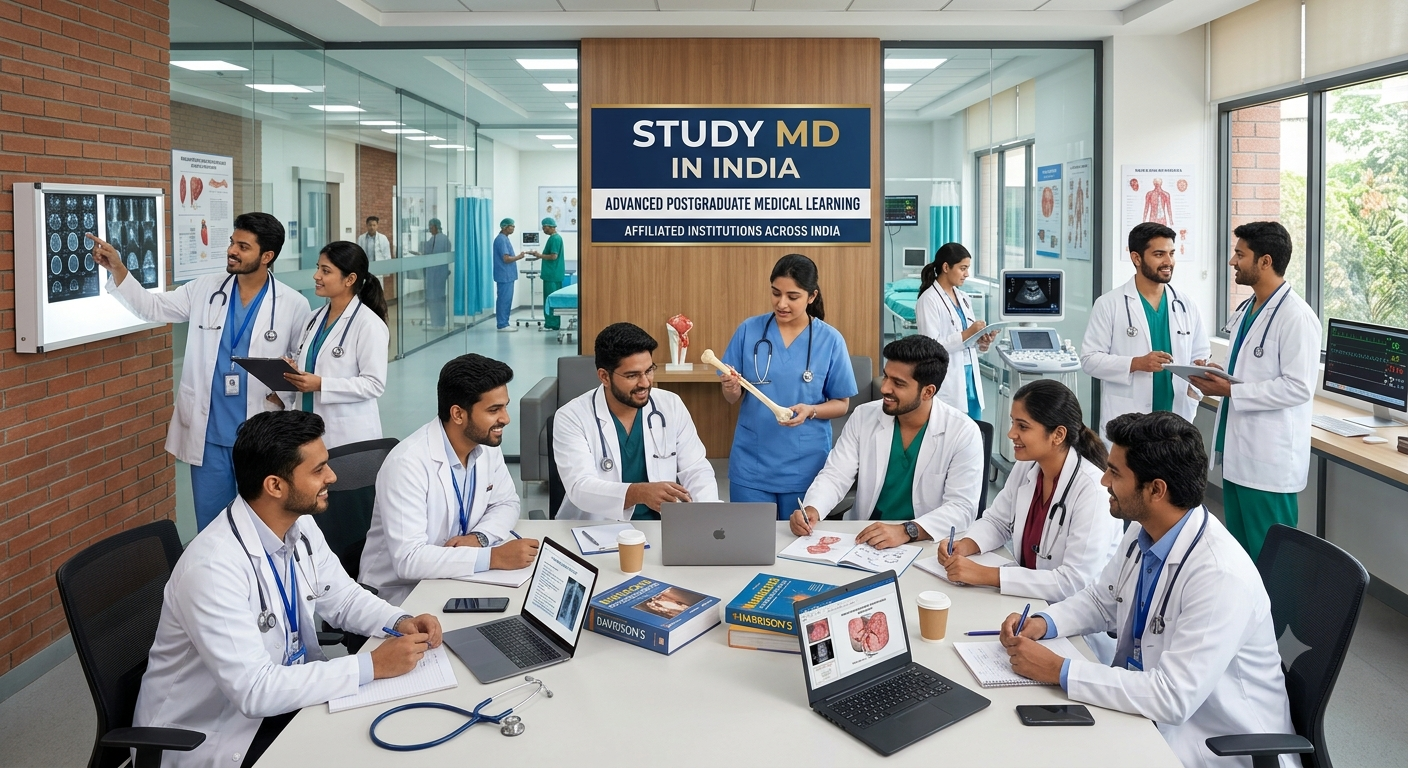
MD in India is a postgraduate medical degree for MBBS graduates who want to develop advanced knowledge and clinical expertise in non-surgical medical specialties. Doctor of Medicine (MD) programs are offered by recognized medical institutions across India in a wide range of specialties.
Admission to MD courses generally involves qualifying NEET-PG and participating in the applicable counselling process. Students can explore government, private, deemed and other recognized medical institutions according to their eligibility, NEET-PG performance, category, available seats and counselling rules.
If you are planning to pursue MD in India, MBBS India can provide guidance on postgraduate medical admission, college selection, counselling, documentation and the overall admission process.
Admission is open for 2026
Why Study MD in India?
India has a large network of medical colleges and teaching hospitals offering postgraduate medical education. An MD program allows medical graduates to develop specialized knowledge while gaining practical exposure in clinical environments.
Some important reasons to consider MD in India include:
- Wide range of postgraduate medical specialties
- Access to teaching hospitals and clinical departments
- Practical exposure to different patient cases
- Experienced medical faculty
- Structured postgraduate medical training
- Government and private medical college options
- Opportunities for further specialization
- Career opportunities in hospitals, healthcare institutions and academics
The quality of education, infrastructure, patient exposure and facilities can vary between institutions. Therefore, students should carefully evaluate colleges before selecting their preferences.
Popular MD Specializations in India
MD programs are available across several clinical, para-clinical and pre-clinical disciplines, depending on the institution and current approvals.
Some commonly available MD specialties include:
- MD General Medicine
- MD Paediatrics
- MD Dermatology
- MD Psychiatry
- MD Radiodiagnosis
- MD Anaesthesiology
- MD Pathology
- MD Pharmacology
- MD Microbiology
- MD Physiology
- MD Anatomy
- MD Biochemistry
- MD Community Medicine
- MD Respiratory Medicine
- MD Emergency Medicine
- MD Nuclear Medicine
The availability of individual specialties differs from college to college. Candidates should check the latest official seat matrix and recognition details before making their choices.
MD Admission in India
The MD admission process in India generally starts with NEET-PG and continues through the relevant counselling process.
Step 1: Complete MBBS
Candidates must complete an MBBS degree from a recognized medical institution and fulfil the applicable eligibility conditions.
Step 2: Complete Internship
Candidates generally need to complete the required internship within the prescribed timeline.
Step 3: Qualify NEET-PG
Eligible medical graduates need to appear for and qualify in NEET-PG as required under the applicable postgraduate medical admission regulations.
Step 4: Register for Counselling
After the examination, eligible candidates need to register for the appropriate counselling process based on the type of seat and institution they are seeking.
Step 5: Choice Filling
Candidates select their preferred MD specialties and medical colleges according to their eligibility, rank, category and available seats.
Step 6: Seat Allotment
Seats are allotted according to the applicable counselling rules, merit, preferences, category and availability.
Step 7: Document Verification
Candidates must submit and verify the required documents within the prescribed schedule.
Step 8: Join the College
After completing the required formalities and applicable fee payment, students report to the allotted institution and begin their postgraduate program.
Counselling dates, eligibility conditions, fee structures and admission rules can change from one admission cycle to another. Candidates should always check the latest official notifications.
Eligibility for MD in India
Candidates planning to pursue MD in India generally need to satisfy requirements such as:
- An MBBS degree from a recognized medical institution
- Completion of the prescribed internship
- Qualification in NEET-PG
- Valid medical registration as applicable
- Fulfilment of counselling requirements
- Required academic and identity documents
Additional conditions may apply depending on the counselling authority, institution, category and type of seat.
Documents Required for MD Admission
Students should keep their documents prepared before starting the counselling process. Common documents may include:
- MBBS degree or provisional certificate
- MBBS marksheets
- Internship completion certificate
- NEET-PG admit card
- NEET-PG result or scorecard
- Medical registration certificate
- Class 10 certificate
- Class 12 certificate
- Valid identity proof
- Recent passport-size photographs
- Category certificate, if applicable
- Domicile certificate, where required
- Migration or transfer certificate, where applicable
- Counselling registration documents
The exact documentation requirements may differ according to the counselling authority and institution.
Types of MD Colleges in India
Students can find MD programs through different types of recognized medical institutions.
Government Medical Colleges
Government medical colleges provide postgraduate medical education in various specialties. Admission, seat availability and applicable fees are governed by the relevant regulations and counselling procedures.
Private Medical Colleges
Private institutions offer MD programs in multiple specialties. Candidates should compare tuition fees, clinical exposure, infrastructure, faculty, teaching hospital facilities and other institutional factors.
Deemed Universities
Deemed universities also offer postgraduate medical programs through the applicable counselling framework. Students should verify current recognition, seat availability and fee details before selecting an institution.
How to Choose an MD College in India?
Choosing an MD college requires more than simply comparing college names. Students should consider several academic and practical factors.
1. Course Recognition
Verify that the specific MD program and institution have the required recognition and approvals.
2. Teaching Hospital
Clinical exposure is an important part of postgraduate medical education. Evaluate patient volume, departments, emergency services and hospital facilities.
3. Faculty
Experienced and qualified faculty can contribute to academic learning, clinical training and professional development.
4. Infrastructure
Consider laboratories, diagnostic facilities, libraries, classrooms, hostels and other student resources.
5. Specialty
Select a specialty based on your academic interests, career plans and eligibility rather than choosing only on the basis of college name.
6. Fee Structure
Compare tuition and other applicable charges carefully. Fees may vary significantly according to the institution, specialty and seat category.
7. Location
Consider accessibility, accommodation, living expenses and the overall learning environment when evaluating a medical college.
Clinical Exposure During MD
Postgraduate medical education combines academic learning with clinical training. Depending on the specialty, students may receive exposure to:
- Outpatient departments
- Inpatient wards
- Emergency services
- Diagnostic procedures
- Clinical case discussions
- Departmental seminars
- Medical investigations
- Hospital rounds
- Academic presentations
- Research activities
The actual level of exposure depends on the specialty, institution, teaching hospital and training structure.
Career Opportunities After MD in India
An MD qualification can provide opportunities across various healthcare and academic settings. After completing postgraduate training, doctors may pursue careers as:
- Specialist doctors
- Senior Residents
- Medical Consultants
- Government healthcare professionals
- Private hospital specialists
- Academic faculty
- Clinical researchers
- Healthcare professionals in specialized institutions
- Medical advisors
- Further super-specialty training
Doctors may also pursue DM or other advanced qualifications, depending on their MD specialty and eligibility.
Why Choose MBBS India for MD Admission Guidance?
Finding the right postgraduate medical college can be challenging because students need to understand NEET-PG counselling, specialties, seat categories, eligibility and documentation.
MBBS India can assist students with guidance related to:
- MD admission planning
- NEET-PG counselling
- College selection
- Specialty selection
- Understanding seat categories
- Document preparation
- Counselling registration
- Choice filling
- Comparing available colleges
- Admission procedure guidance
Our objective is to make the postgraduate admission journey more organized and easier to understand.
Admission remains subject to the candidate’s eligibility, NEET-PG performance, counselling rules, seat availability and the latest applicable regulations.
Begin Your MD Admission Journey
Planning to pursue MD in India after completing your MBBS? Get guidance for postgraduate medical admission, college selection and counselling.
Contact Us: +91 8010204555
Website: mbbs-india.com